
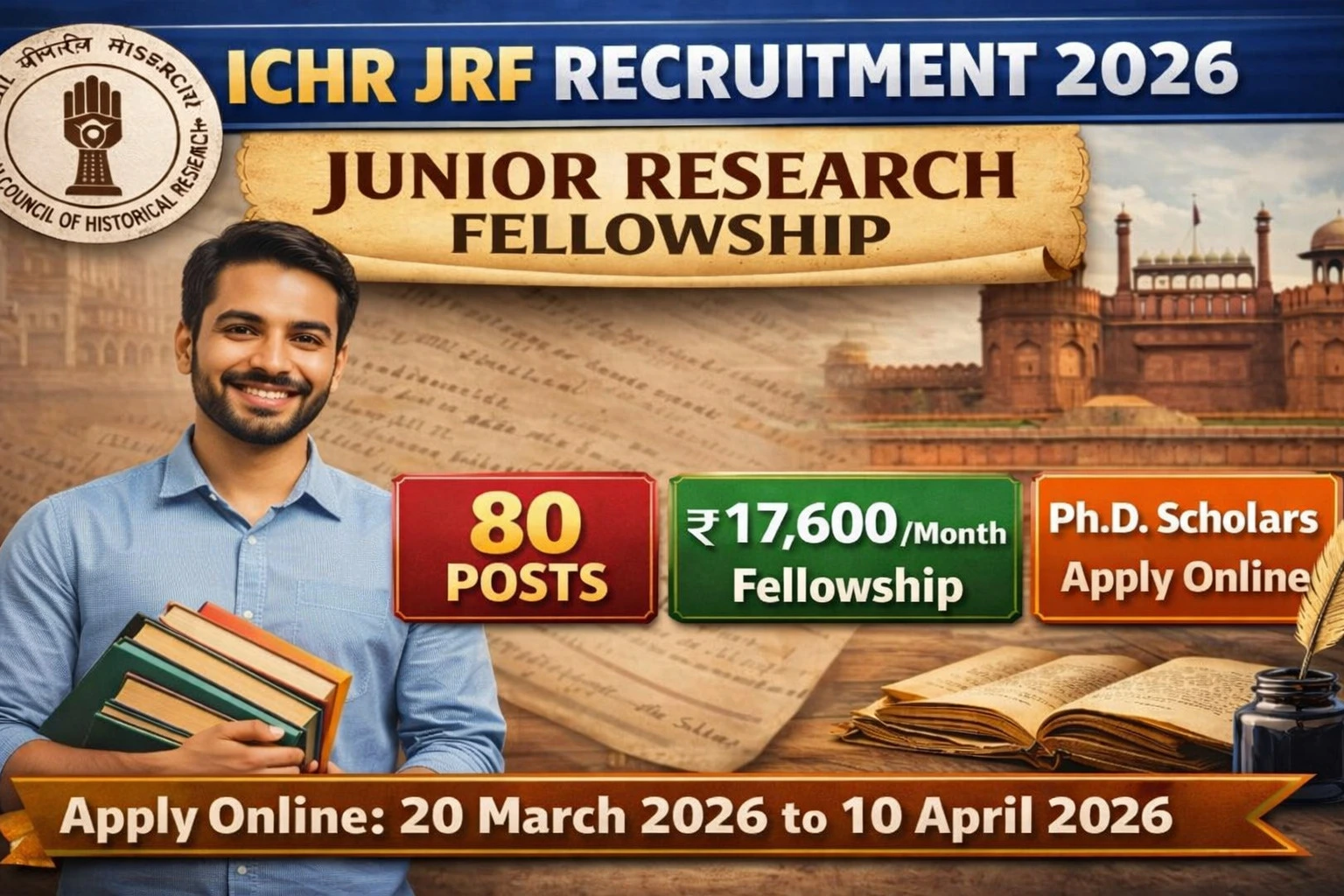
ICHR JRF Notification 2026: Applications are invited from the eligible candidates for the 80 Junior Research Fellowships (JRF) for the academic year 2025-2026 by Indian Council of Historical Research (ICHR), New Delhi. The selected Junior Research Fellowships (JRF) will be awarded fellowship of Rs.17,600/- per month with Contingency Grant of Rs.16,500/- per annum for a period of Two years. Candidates who have registered for Ph.D. Programme in historical studies at recognized universities are eligible to apply.
The notification was published on 20th March 2026, inviting applications from eligible candidates registered for a Ph.D. program in historical studies. Online application opens on 20th March 2026 and closes on 10th April 2026. Eligible candidates can submit their applications online through the official ICHR website, www.ichr.ac.in. The printout of the filled application form must reach the ICHR office by 17th April 2026. This article provides detailed information regarding eligibility criteria, important dates and links, the total number of vacancies, required qualifications, job locations, the application process, and more.
ICHR JRF Recruitment Overview
The ICHR JRF is a prestigious fellowship awarded to promising researchers to pursue their doctoral studies in the field of history. The selection process will be based on two stages: an online entrance examination (Stage-I), followed by a presentation-cum-interview (Stage-II). Selected researchers will receive a monthly fellowship and an annual contingency grant.
| Particulars | Details |
| Organization | Indian Council of Historical Research (ICHR), New Delhi |
| Fellowship Name | Junior Research Fellowships (JRF) |
| Academic Year | 2025-2026 |
| Total Fellowships | 80 |
| Notification No. | 01-1/2025-26/JRF Exam/ICHR |
| Application Fee | Rs. 500 (Exempted for SC/ST/PwD candidates) |
| Qualification | Must have registered for Ph.D. Programme in Historical Studies (Ancient/ Medieval/ Modern India) at a recognized university |
| Registration Start Date | 20th March 2026 |
| Registration End Date | 10th April 2026 |
| Selection Process | Stage-I: Online Entrance Test Stage-II: Presentation-cum-Interview |
| Fellowship Amount | Rs. 17,600/- per month + Rs. 16,500/- per annum (contingency grant) |
| Apply Mode | Online + Hard Copy (Printout) |
| Official Website | http://ichr.ac.in/ |
- ICHR JRF Recruitment 2026 Syllabus, Research Fellowship Eligibility, Salary, Apply Online
- NFC Recruitment 2026 Vacancy, Eligibility, Salary, Exam Pattern & Application Process Complete Details

- UPSSSC AGTA Recruitment 2026: Syllabus, Eligibility, Salary, Exam Pattern, Fees & Apply Online Now

ICHR JRF Recruitment Important Dates
The ICHR has announced the JRF application process and key examination dates. The dates for the online entrance examination and the presentation-cum-interview will be notified shortly on the official website.
- Online Application Commences: 20/03/2026
- Last date for online submission: 10/04/2026
- Last date for submitting printouts of filled application form: 17/04/2026
- Stage-I (Online Entrance Test) Date: Notify soon
- Stage-II (Presentation-cum-Interview) Date: Notify soon
- Admit Card available: Notify soon
ICHR JRF Recruitment Important Links
- Download JRF Recruitment 2026 Official Notification PDF
- Apply Online for NFC Recruitment 2026 Form
- 🚀 Visit official website of Nuclear Fuel Complex (NFC)
- 📢 Join Telegram for Daily Job Alerts
- 💬 Join WhatsApp Channel for Updates
ICHR JRF Recruitment Salary
The selected fellows will be awarded fellowship and Contingency Grant.
- Fellowship : Rs.17,600/- (Rupees Seventeen Thousand and Six Hundred only) per month
- Contingency Grant : Rs.16,500/- (Rupees Sixteen Thousand and Five Hundred only) per annum
- Period: Two years (extendable up to one more year without financial commitment under special circumstances)
ICHR JRF Recruitment Education Qualification
Candidates who have registered in recognized universities for Ph.D. Programme in historical studies are eligible to apply for the ICHR Junior Research Fellowships (JRF).
ICHR JRF Recruitment Application Fees
- General : Rs. 500/-
- OBC : Rs. 500/-
- SC : NIL
- ST : NIL
- PwBD : NIL
ICHR JRF Recruitment Selection Process
- Final merit will be prepared based on combined marks of both stages:
- Stage I (100 Marks) + Stage II (60 Marks) = 160 Marks (Total)
- Selection will be made strictly on the basis of aggregate performance
ICHR JRF Recruitment Exam Pattern
The selection process will be conducted in 2 Stages
Stage I – Online Examination (100 Marks)
- The exam will consist of 100 objective-type questions conducted online
- Each question carries 1 mark
- No negative marking
- Candidates must choose their area of specialization while filling out the JRF application form:
- Ancient India
- Medieval India
- Modern India
- All questions will be based on the selected specialization (Refer Annexure A)
- The question paper will be bilingual:
- English
- Hindi
Stage II – Presentation-cum-Interview (60 Marks)
- Candidates will be shortlisted based on Stage I merit
- Shortlisted candidates must:
- Give a presentation (8–10 minutes)
- Topic: Their registered Ph.D. research topic
- Mode: Preferably PowerPoint Presentation
- This will be followed by a personal interview
- Maximum Marks: 60
- 📌 Important: Candidates must carry their Stage I Hall Ticket while attending Stage II
ICHR JRF Recruitment Syllabus
Unit- I: Ancient Indian History (From Earliest time up to 12th Century)
- India: Geography, physical features, environment, flora-fauna, concept of Bharatvarsha and Vrihadbharata (Greater India)
- Sources of ancient Indian history: literary sources, archaeological sources, inscriptions, coins, monuments and sculptures, foreign travellers’ accounts, ancient Indian historians and great personalities
- Archaeology: Definition, excavation and survey methods, preservation of antiquities, dating methods, tools and technology, pottery traditions, recent excavations, new researches, new archaeology, Iconography & Iconology
- Pre-history of India: Origin and evolution of human being, Palaeolithic, Mesolithic, Neolithic Age
- Chalcolithic culture: Ahara, Kayatha, Malwa, Jorwe
- Saraswati-Indus civilization: Origin, urbanization, extent and decline, dating, economy, society, script, town planning, art and architecture and religion
- Megalithic age: Origin, extent, potteries, social life; Iron in India
- Vedic culture: Literature, political, economic and social life, religion and philosophy
- Shramana Traditions: Bauddha, Jaina, Ajivaka, Tapas and Gairika – literature, origin and evolution, religious and social life, art and architecture
- Political and cultural history of North India: Second urbanization in India (6th Century BC), Mahajanapadas and Ganarajyas, rise of Magadha, Haryankas, Shishunagas, Nandas, Mauryan Empire, Shungas-Kanvas, Andhra-Satavahanas, Chedis, Indo-Greeks, Shaka-Kshatrapas, Pahlavas, Kushanas, Vakataka Dynasty, Gupta empire, Toramana Huna, Yashodharma of Malwa, Maitrakas, Maukharis of Kannauja, Later Guptas of Malwa, Vardhan Dynasty, Varmanas of Kamrupa, Dynasties of Kashmir, Palas, Senas, Gurjara-Pratiharas, Gahadavalas, Chahamanas, Parmaras, Chandelas, Kalchuri of Tripuri and Solanki Dynasty (Chaulukyas)
- Political and cultural history of South India: Sangam Period, Chalukya, Rashtrakutas, Pallavas, Gangas, Kadambas, Chola Dynasty, Cheras, Pandyas and Yadavas
- Social, religious, economic and cultural history of ancient India
- Art, architecture, scripts, science and technology in ancient India
- Expansion of Bharatiya culture with special reference to Asia
- Research methodology, research aptitude and computer applications
Unit- II: Medieval Indian History
- Sources of Medieval Indian History: Literary Sources – Persian, Sanskrit, Regional Languages & Foreign Travellers’ Accounts; Archaeological Sources – Archaeological, Epigraphic & Numismatic; and historiographical developments
- Historical Geography of Medieval India
- Indian resistance against Arab and Turkish invasions (712–1192 AD)
- The Ahom Kingdom
- Delhi Sultanate – Polity, society, economy, religion, art, architecture, science & technology
- Regional Powers: Gujarat, Jaunpur and Bengal
- Kakatiyas, Hoyasalas, Yadavas, Cholas and Pandyas – polity, society, economy, religion, art, architecture, science & technology
- Vijayanagar Empire – polity, society, economy, religion, art, architecture, science & technology; and Nayakas
- The Bahmani and Deccan Sultanates (Bijapur, Golkonda, Bidar, Berar and Ahmadnagar) – rise, expansion and decline; the Gond Kingdom
- Mughal Rule – polity, administration, economy, visual and performing art, architecture and literature, society and education; Sher Shah Suri – innovations & administrative reforms
- Rise of the Marathas and the foundation of Swaraj by Chhatrapati Shivaji, expansion of Maratha power, Maratha administration
- Rural society & economy, peasantry, agricultural productions & cottage industries
- Urban economy: trade, commerce, craft, merchants & banking systems
- Development of literature, music, art, architecture, education and science & technology
- Consciousness and religio-philosophical movements – Dvaita, Advaita, Visishtadvaita, Suddhadvaita; Bhakti, Sufi and Sikh
- Hindu resistance to Muslim domination with special reference to Rajputs, Marathas, Jats, Bundelas & Sikhs
- Research methodology, research aptitude and computer applications
Unit- III: Modern Indian History
- Sources of Modern Indian History and historiographical developments
- Advent of European powers in India: cultural and economic bases of colonialism
- East India Company and consolidation of British power
- Institutional changes during the colonial times – revenue; education (idea, content and vision); judiciary; army; bureaucracy; police
- Resistance with special reference to peasants & tribal protests during the Company and the British Raj
- The First War of Independence 1857: its impact and geographical extent
- Socio-religious reform movements: reforms breaking away from traditions and reforms in defense of traditions
- Shift from mercantilism to capitalism and rise of Swadeshi
- Concept of nation and nationalism in India and its new features in the later 19th century
- Nationalist activities (1858–1920): revolutionary movement in India and abroad; constitutional agitation by Indian National Congress and the Swadeshi Movement; reactions to colonial milieu – Tilak’s idea of ‘Swaraj’ and Sri Aurobindo’s political philosophy; early Gandhian movements
- Nationalist activities (1920–1947): Gandhian movements; revolutionary activities in India and abroad; peasants, tribal and trade union movements; political philosophy of the communists in context to the Indian National Movement; fallout with the Congress and Netaji Subhash Chandra Bose, INA and the impact of INA trials
- Philosophy and vision of Periyar, Narayan Guru, Rabindranath Tagore, Gopal Krishna Gokhale, Madan Mohan Malaviya, Dr B.R. Ambedkar, Vinayak Damodar Savarkar, Sir Syed Ahmad Khan, Hanuman Prasad Poddar, Subramania Bharati, Acharya Vinoba Bhave, Manabendra Nath Roy, C.B. Ramaswami Aiyyar
- Contribution of women in the Indian National Movement
- Research methodology, research aptitude and computer applications
- ICHR JRF Recruitment 2026 Syllabus, Research Fellowship Eligibility, Salary, Apply Online
- NFC Recruitment 2026 Vacancy, Eligibility, Salary, Exam Pattern & Application Process Complete Details
- UPSSSC AGTA Recruitment 2026: Syllabus, Eligibility, Salary, Exam Pattern, Fees & Apply Online Now
ICHR JRF Recruitment Examination centres
🔹 Stage I – Online Examination Centres
- The online exam will be conducted in the following cities:
- New Delhi (Delhi)
- Bengaluru (Karnataka)
- Guwahati (Assam)
- Pune (Maharashtra)
🔹 Stage II – Presentation-cum-Interview
- Venue: ICHR Headquarters, New Delhi
- Mode: Hybrid (Online + Offline)
⚠️ Important Note : Only candidates shortlisted from Stage I (based on merit) will be called for Stage II
- 🚆 Travel Allowance (TA) Applicable for Only SC / ST / PwBD candidates
- Reimbursement: Second Class (Sleeper) Railway fare or Bus fare By the shortest route
- Travel can be from: Nearest Railway Station/Bus Stand from residence OR Place from where the journey actually begins (whichever is nearer to the exam venue)
- 📏 Condition: Distance must be at least 30 km
- 🎫 Candidates must produce original tickets to claim reimbursement
How to Apply for ICHR JRF Recruitment
Follow these easy step to apply for the ICHR JRF Recruitment 2025 – 2026
- Eligible and interested scholars may apply online through the official ICHR website:
- www.ichr.ac.in
- Visit the website and click on “Junior Research Fellowships (JRF) 2025-2026” or the “Online Application” link
- Register yourself by providing the required basic details. A unique ID number will be generated
- Log in using your credentials and fill out the online application form carefully with:
- Personal details
- Educational qualifications
- Research details
- Candidates must select their area of specialization in (Ancient / Medieval / Modern India) while filling the form
- Upload scanned copies of:
- Recent photograph
- Signature
- Required documents
- Pay the application fee of Rs. 500/- (online only) if applicable
- SC / ST / PwBD candidates are exempted from fee payment
- Submit the online application form and take a printout of the completed form (with auto-generated number)
- The printed application form must be:
- Duly signed
- Attached with self-attested copies of required documents, including:
- Ph.D. registration certificate
- Educational qualification certificates
- Experience certificate
- Signed copy of checklist (Annexure B)
Send the complete hard copy by post to the following address:
To,
The Member Secretary
Indian Council of Historical Research
35, Ferozeshah Road
New Delhi – 110001
⚠️ Important Instructions
- Submission of both online application and hard copy is mandatory
- The hard copy must contain the computer-generated unique ID number
- Applications without unique ID number will not be accepted
FAQ
Q1. What is ICHR JRF Recruitment 2026?
ICHR JRF Recruitment 2026 is a fellowship program conducted by the Indian Council of Historical Research (ICHR) to award 80 Junior Research Fellowships to Ph.D. scholars in historical studies.
Q2. What is the last date to apply for ICHR JRF 2026?
Last date to apply online: 10 April 2026
Last date to submit hard copy: 17 April 2026
Q3. What is the fellowship amount for ICHR JRF 2026?
Selected candidates will receive fellowship of ₹17,600 per month along with a ₹16,500 annual contingency grant.
Q4. What is the application fee for ICHR JRF Recruitment 2026?
General candidates: ₹500
SC/ST/PwBD candidates: No fee
Q5. What is the eligibility for ICHR JRF Recruitment 2026?
Candidates must be registered for a Ph.D. programme in Historical Studies (Ancient, Medieval, or Modern India) at a recognized university.
Q6. How many vacancies are available in ICHR JRF 2026?
A total of 80 Junior Research Fellowships (JRF) have been announced with reservation for SC, ST, and PwD categories.
Q7. What is the duration of the ICHR JRF fellowship?
The fellowship is awarded for 2 years, which may be extended by 1 additional year under special conditions.
Q8. What is the selection process for ICHR JRF 2026?
The selection process includes:
Stage I: Online Entrance Test (100 marks)
Stage II: Presentation-cum-Interview (60 marks)
Q9. Is it mandatory to submit a hard copy for ICHR JRF 2026?
Yes, submission of both online application and hard copy with a unique ID is mandatory.
Applications without a unique ID will be rejected.
Q10. How can I apply for ICHR JRF Recruitment 2026?
Candidates must:
Apply online through the official website
Send a printed application form along with documents to the ICHR office in New Delhi